
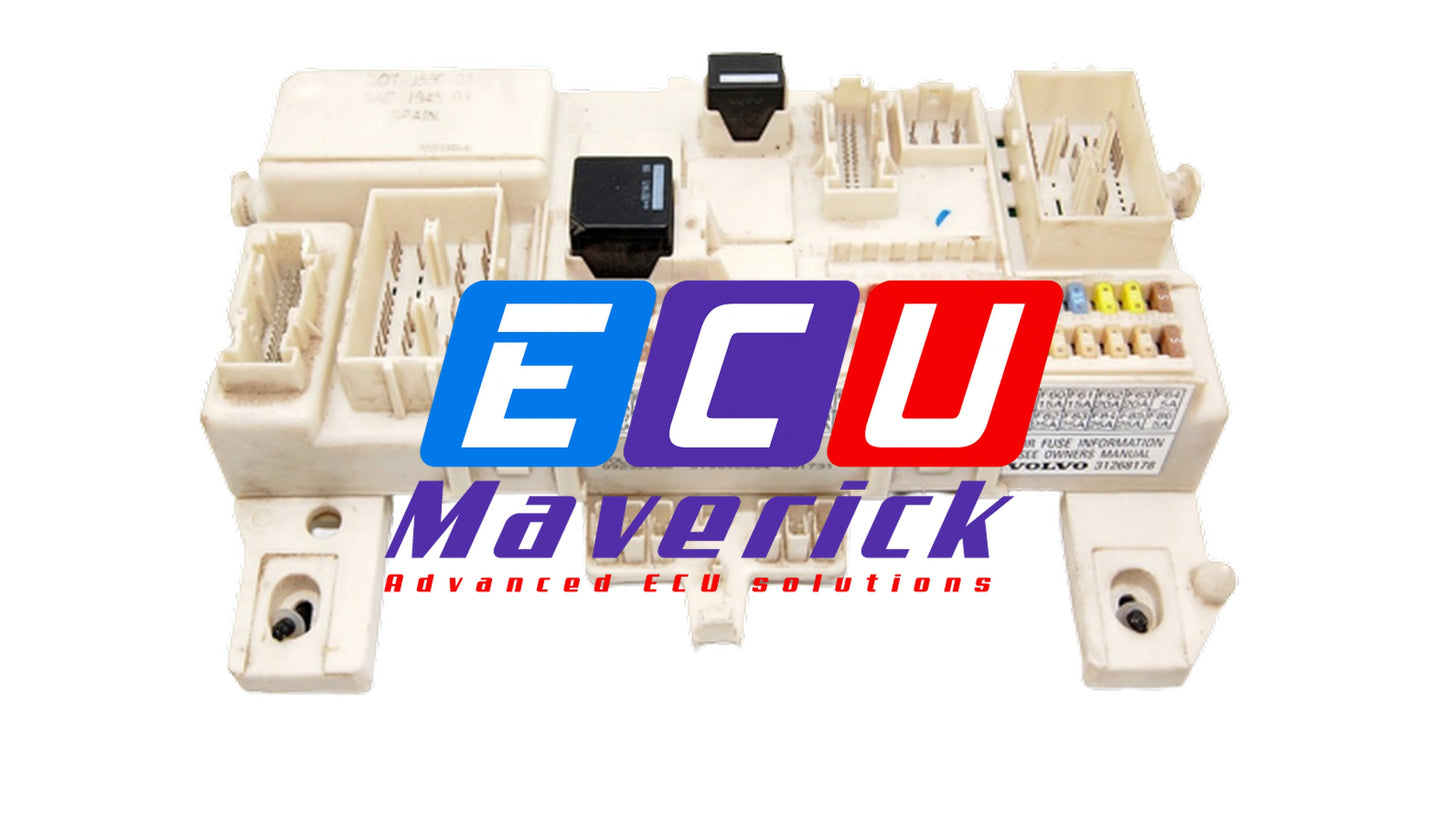
Aston Martin Rapide DB9 Vantage Vanquish Central Electronic Module CEM Fuse Box BCM Body Control Module Immobilizer
Aston Martin Rapide DB9 Vantage Vanquish Central Electronic Module CEM Fuse Box BCM Body Control Module Immobilizer
Couldn't load pickup availability
Have a faulty BCM? Intermittent issues?
Need another BCM programmed? Plug & Play?
Place your order, print your order number and ship it with your BCM, we will take care of the rest!
Your replacement CEM will be an identical clone of your original!
We provide our own part + warranty!
Turnaround: 2-3 Business Days!
Please note, if your part has water damage, additional charges will apply! Contact us for details!
8G43-14C245-AA 8G4314C245AA
Aston Martin CEM Failure: Everything You Need to Know About the Central Electronic Module (8G43-14C245-AA)
ECU Maverick - Aston Martin ECU & CEM Specialists
If your Aston Martin has started acting strangely — warning lights flooding the dash, windows refusing to budge, the key not being recognized, or worse, the car refusing to start — there is a very good chance the Central Electronic Module (CEM) is to blame. It is one of the most talked-about failure points on the entire Gaydon-era Aston Martin range, and yet it remains one of the least understood.
In this guide we break down exactly what the Aston Martin CEM is, what it controls, how and why it fails, what your options are when it does, and what you need to know before ordering a replacement.
What Is the Aston Martin CEM?
The Aston Martin Central Electronic Module, part number 8G43-14C245-AA, is the body and convenience computer at the heart of every Gaydon VH-platform Aston Martin built between approximately 2004 and 2016.
It sits in the passenger footwell and physically houses the cabin fuse bank, making it both the power distribution hub and the brain of the entire body electrical system.
Vehicles fitted with the 8G43-14C245-AA CEM include:
- Aston Martin DB9 (2004–2016)
- Aston Martin V8 Vantage (2005–2016)
- Aston Martin V12 Vantage
- Aston Martin DBS V12
- Aston Martin Rapide
- Aston Martin Virage
- Aston Martin Vanquish (2012+)
- Aston Martin V12 Zagato
- Aston Martin Vantage GT8
What Does the Aston Martin CEM Control?
The CEM is far more than a fuse box. It is the central nervous system for virtually every non-engine function in the car and acts as the gateway between the high-speed and low-speed CAN bus networks. Its responsibilities include:
- Interior and exterior lighting — headlights, tail lights, indicators, fog lights, brake lights, interior cabin lighting
- Power windows and sunroof — all window lift motors route through the CEM
- Central locking and keyless entry — all door lock commands are processed here
- Security and immobiliser — the CEM handles key transponder authentication and works in conjunction with the ECM to immobilise the engine if a valid key is not recognised
- Windscreen wipers and washers — front wiper, rear wiper, headlamp wash/wipe
- Power management and load shedding — when battery voltage drops low, the CEM sheds non-essential circuits (radio, heated screen, windows) to protect engine and transmission supply
- Seat heaters, climate blower fan, and heated screen
- Fuel pump relay and fuel level signals
- CAN/LIN network gateway — this is critical: the CEM routes communication between the engine (ECM), transmission (TCM), ABS/brake module (BCM), airbag module (SRS), instrument cluster (DIM), door modules (DDM/PDM), climate module (CCM), parking aid (PAM), differential module (DEM), and many others
When the CEM fails or loses communication, the entire network can collapse — which is why a single faulty CEM can simultaneously trigger ABS, airbag, traction control, and brake warnings alongside seemingly unrelated faults like the windows not working or the radio resetting.
Common Aston Martin CEM Failure Symptoms
Owners and technicians across the Aston Martin community report the following warning signs when the CEM is beginning to fail:
Electrical "Gremlins"
- Intermittent or completely dead power windows
- Door locks cycling on their own or not responding
- Key fob working one day and not the next
- Interior lights behaving erratically
- Wipers running on their own or refusing to start
- Radio and climate settings resetting at random
Warning Light "Christmas Tree"
- ABS, Brake, Traction Control (DSC), Stability Control warnings illuminating simultaneously
- "Brake — Stop Safely" message appearing without cause
- Airbag / SRS warning light on
- Tyre System Fault message (often blamed on TPMS but actually a CAN bus communication loss)
- Red key / immobiliser warning light
Starting Problems
- No crank, no start
- Car cranks but will not fire (immobiliser active due to key not being recognised)
- Intermittent no-start that clears after the car sits — classic thermal shutdown behaviour
Battery and Power Issues
- Battery draining overnight or within hours (parasitic drain — CEM failing to put modules to sleep)
- Random loss of power to instruments
Why Do Aston Martin CEMs Fail? The Full Picture
Water damage gets most of the attention, and for good reason — the CEM's location in the passenger footwell makes it vulnerable to any leak from the windscreen, sunroof drains, or door seals. However, water intrusion is only one of several well-documented failure modes:
1. Water and Flood Damage
Rain water entering through blocked A-pillar or sunroof drains, leaking windscreen seals, or door seams pools in the footwell and contacts the CEM's connectors and PCB. Even minor damp exposure accelerates corrosion.
2. Connector Pin Corrosion and Breakage
The large multi-pin connector — particularly the blue plug — is prone to green oxidation and physical pin breakage, especially if the CEM has ever been removed. Corroded or broken pins interrupt communication with one or more modules on the network and produce a cascade of seemingly unrelated DTCs.
3. "Fuse 15" Power Feed Loss
A specific and well-known failure in the Volvo P1 CEM family: the board-level circuit that supplies 12V power to the Brake Control Module (BCM) fails. The result is loss of ABS, traction control, and stability control function — exactly the combination of warning lights that often sends Aston owners to the dealer convinced they need brake module work, when the real fault is inside the CEM.
4. Solder Joint Failures
Thermal cycling and vibration over years of use crack solder joints on the PCB — particularly on the power board's high-current components and onboard relays. Intermittent faults that come and go with temperature are a classic indicator.
5. CAN/LIN Transceiver Faults
The CEM's internal CAN transceivers can fail, causing the unit to go "bus off" and cutting communication with every module on the network. The result looks like catastrophic total electrical failure.
6. EEPROM Corruption from Low Voltage
Cranking the engine when the battery is low, or disconnecting the battery carelessly, can corrupt the CEM's stored configuration data. This produces a no-start condition and may trigger a "no keys stored" error — the car effectively forgets your keys.
7. Thermal Shutdown
Earlier CEM units are particularly susceptible to overheating in warm climates or after sustained low-speed driving. The unit shuts itself down to protect internal components, producing an intermittent no-start that mysteriously resolves once the module cools.
8. Parasitic Battery Drain
A failing CEM may not send all modules to sleep when the car is locked, drawing current continuously. Owners often chase this fault through the BCM, radio, and tracker before realising the CEM is the culprit.
Aston Martin CEM Diagnostic Trouble Codes (DTCs)
When scanned with a compatible diagnostic tool (Foxwell NT530, Autel, or AMDS), a failing Aston Martin CEM commonly throws codes including:
- CEM-1D02 / 1D07 / 1D08 / 1D09 — Internal CEM fault
- CEM-DF07 — Low-side short circuit
- CEM-DF13 / DF16 / DF17 — CAN signal fault
- CEM-E001 / E00A — Low-speed CAN transmit/receive error and bus-off
- CEM-1A51 through 1A65 — Communication lost with SRS, door modules, instrument cluster, ECM, TCM, etc.
- CEM-8F04 / 8F05 / 8F12 / 8F21 / 8F22 / 8F2F / 8F52 — Relay and lamp faults (wiper, wash/wipe, high/low beam, turn signals)
- CEM-6C48 / 6C49 — Transponder/key faults
- U0140 — Lost communication with Body Control Module
The presence of multiple U-codes (lost communication) alongside internal CEM faults is a strong indicator that the CEM itself — rather than the modules it cannot reach — is the root cause.
Before You Replace the CEM: Check These First
Because the CEM is the network hub, symptoms that look like a CEM failure are sometimes caused by other, cheaper issues:
1. Test and charge the battery. A weak battery producing low voltage during cranking creates nearly identical gremlins — lost comms, warning lights, no-start, window faults. Load-test your battery before touching the CEM.
2. Inspect grounds. Corroded engine and chassis ground connections can produce widespread electrical faults that mimic a failed CEM.
3. Check the tracker. A surprisingly common cause of ABS, brake, and traction control warnings on Aston Martin VH-platform cars is a failing Cobra or Trakm8 GPS tracker (factory-fitted or dealer-added) dumping corrupt signals onto the CAN bus. Disconnecting the tracker has resolved the problem for many owners at zero cost.
4. Scan all modules. Use a tool that reads body and chassis modules, not just engine codes. If all fault codes point toward the CEM as a communication source rather than individual module failures, the CEM is likely at fault.
Replacement and Repair Options
Option 1: CEM Repair (Best Value — Keeps Your Coding)
If your original CEM is recoverable — corrosion, broken pins, fuse-15 fault, or failed solder joints — repair is almost always the smartest route. The repaired unit retains your car's existing coding, meaning it reinstalls as plug-and-play with no AMDS dealer programming required. This is the fastest and most cost-effective path for the majority of CEM failures.
We offer professional CEM repair services covering all common failure modes including board-level re-soldering, pin restoration, fuse-15 power feed repair, and full testing before return.
Option 2: Program Transfer / Cloning (Plug-and-Play from a Donor)
If your original CEM is unreadable — typically after severe water damage or total PCB failure — a part-number-matched used donor unit can be cloned with your car's data and will install plug-and-play. The donor must match the exact printed hardware part number on your original module; even within the P1 CEM family, different numbers use different internal architectures and cannot always be cleanly cloned between each other.
Option 3: New OEM CEM + AMDS Programming
A factory-new 8G43-14C245-AA CEM is available and is priced more accessibly than many forum posts suggest — typically in the region of $780–$985 for the bare module. However, a new CEM is never plug-and-play. It arrives as a virgin unit with no VIN, no configuration, and no keys programmed. Installation requires:
- The Aston Martin Diagnostic System (AMDS) at a dealer or AMDS-equipped specialist
- The car's Car Configuration File (CCF) to be written to the module
- VIN programming
- Immobiliser/key data to be configured
- Aston Martin part 702802 (Car Config) to be ordered alongside the CEM
AMDS programming labour at a dealer adds significant cost on top of the bare part price. For most owners, repair or cloning is the more economical choice.
Part Number Cross-Reference
| Number | Source |
|---|---|
| 8G43-14C245-AA | Aston Martin OEM part number |
| 31327215 | Volvo cross-reference |
| 31268178 | Volvo cross-reference |
| 31254903 | Related Volvo/Aston unit (seen on early DB9) |
| 702802 | Aston Martin Car Config package (order with new CEM) |
Frequently Asked Questions
Q: Can I fit a used Aston Martin CEM from another car? A: Not directly. A used CEM is coded to its donor car's VIN, keys, and configuration. It must be cloned with your car's data before installation, and the donor unit must match your original CEM's exact printed part number.
Q: Will a new CEM work straight out of the box? A: No. A new factory CEM is a blank/virgin unit and requires AMDS programming with your car's VIN, Car Configuration File, and key data. Without this step, the car will not start and will show widespread faults.
Q: My Aston Martin has ABS, traction control, and brake warnings. Is it definitely the CEM? A: Not necessarily — this combination is a classic symptom of the CEM's "fuse 15" power feed fault, but a dying battery, bad grounds, or a failing CAN-bus tracker can produce identical warnings. Diagnose carefully before replacing the module.
Q: My car sits in a barn/garage and the battery died. Now it won't start and shows a key warning. Is the CEM dead? A: This is a common scenario. Deep battery discharge or a voltage spike during a jump-start can corrupt the CEM's EEPROM. In many cases the module can be recovered by a specialist — it does not necessarily need replacement.
Q: What diagnostic tool works with the Aston Martin CEM? A: A Foxwell NT530 (with the appropriate Aston Martin/Volvo software) covers reading and clearing body codes on 2004-2016 cars. The Autel range also covers many functions. Full CEM configuration, flashing, and programming requires the Aston Martin Diagnostic System (AMDS) at a dealer or specialist.
Q: Is the 8G43-14C245-AA the same as the Volvo P1 CEM? A: Yes. The hardware is functionally identical — Aston Martin applied a Ford-style part number to a Volvo P1 unit. This is useful to know because Volvo P1 CEM repair services, cloning tools, and technical knowledge all apply directly to the Aston CEM.
Summary
The Aston Martin CEM (8G43-14C245-AA is a sophisticated body computer and network hub that controls the majority of your car's electrical comfort, security, and power distribution systems. When it fails — whether through water damage, connector corrosion, fuse-15 fault, solder failure, or low-voltage EEPROM corruption — the symptoms range from minor gremlins to total no-start. It is never plug-and-play from new or from a donor, and a correct diagnosis (including ruling out the battery, grounds, and tracker) will save you significant time and money.
If your Aston Martin is showing any of the symptoms described above, we are here to help.
Looking for a repaired, remanufactured, or programmed Aston Martin CEM? Browse our listings or contact us directly — we supply repair services, cloned plug-and-play units, and new modules for the full Gaydon VH-platform range including the DB9, V8 Vantage, V12 Vantage, DBS, Rapide, Virage, and Vanquish.
Keywords: Aston Martin CEM, Central Electronic Module 8G43-14C245-AA, Aston Martin CEM failure, Aston Martin electrical gremlins, DB9 no start, Aston Martin CEM repair, Aston Martin CEM programming, Aston Martin CEM replacement, Aston Martin body control module, Aston Martin fuse box module, Aston Martin CEM cloning, AMDS programming, Aston Martin ABS traction control warning lights, Aston Martin parasitic battery drain, Aston Martin CEM water damage, Vantage CEM, DBS CEM, Rapide CEM, Aston Martin VH platform electrical fault

Remanufactured
We rebuild OEM control modules with upgraded components to prevent common failures. Unlike junkyard parts that may fail within months, our modules are thoroughly tested and backed by a 6-month warranty. If it fails under warranty, reprogramming is free.

How It Works
Ship us your faulty module. We extract your original data (VIN, mileage, key codes, calibrations) and transfer it to a remanufactured unit. Your old module is recycled for parts. You receive a plug-and-play replacement ready to install.

What to Expect
✓ Turnaround: 2-3 business days
✓ Warranty: 6 months
✓ Programming: Not required—plug and drive
✓ Core Required: Yes (your original module)
About ECU Maverick — OEM Remanufactured Plug & Play Control Modules
ECU Maverick supplies OEM-quality remanufactured control modules, pre-programmed and ready to install. Based in Fort Myers, Florida, we serve independent repair shops, dealerships, and vehicle owners nationwide.
Every module we sell is thoroughly tested, remanufactured to OEM specifications, and programmed to your specific vehicle. No dealer visits, no additional coding, no hassle, ust plug in and drive.
Vehicles We Support
We stock and program modules for European luxury and performance brands, including BMW, Mercedes-Benz, Audi, Porsche, Land Rover, Bentley, Ferrari, Lamborghini, Maserati, and Aston Martin. We also carry modules for domestic vehicles, heavy equipment, and marine applications.
Why Automotive Repair Facilities and Owners Buy From Us
Plug-and-Play Ready — Every module ships pre-programmed and coded to your VIN. No dealer required.
Fast Shipping — Most orders ship within 2–3 business days. Same-day rush available.
OEM Quality — Remanufactured to original equipment standards with component-level inspection and testing.
Direct Support — Text or call us to speak with a real person. We help you find the right module the first time.
6-Month Unlimited Mileage Warranty — Drive with confidence. Our warranty covers you regardless of how many miles you put on.
Our Commitment
We exist to keep your vehicle out of the dealership and back on the road—with quality parts, transparent pricing, and expert support from start to finish. Every module we sell meets the same standards we'd expect for our own vehicles.